About the Journal
Chemical science · Open knowledge · Future directions
Chemical Problems
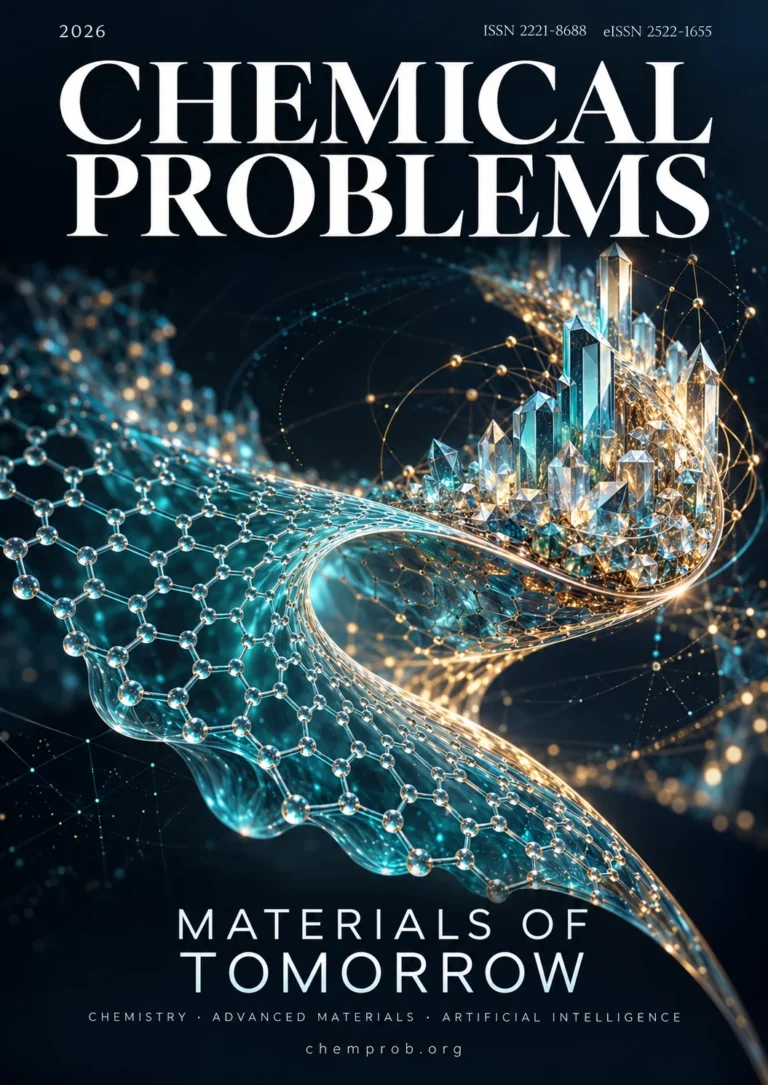
Chemical Problems is a peer-reviewed, open-access journal publishing original research and reviews across the chemical sciences. Published in Baku, Azerbaijan, the journal connects fundamental chemical understanding with research on materials, energy, the environment and industrial processes.
Our purpose is to make carefully evaluated research accessible to the international scientific community and to support meaningful exchange between disciplines, institutions and generations of researchers.
Aims & Scope
The journal seeks research that advances chemical knowledge through a clearly defined question, appropriate methods and conclusions supported by evidence. It provides a forum for experimental and theoretical work, as well as reviews that critically examine progress and identify questions for further investigation.
- Organic, inorganic and physical chemistry
- Organometallic and coordination chemistry
- Chemical kinetics and catalysis
- Electrochemistry
- Polymer chemistry
- Materials science and crystal chemistry
- Nanochemistry and functional materials
- Petrochemistry and petroleum refining
- Biochemistry
- Environmental chemistry and alternative energy sources
Across these areas, the journal values a clear account of what is new, why it matters and how the findings can be evaluated and built upon by other researchers.
History & Journal Identity
Founded on 19 September 2002 by Professor Akif Sh. Aliyev, the journal began publication in 2003. The enterprise Turan joined as a co-founder in 2004. The R. Agladze Institute of Inorganic Chemistry and Electrochemistry, Georgia, is an honorary co-founder.
| Publisher | Chemical Problems Journal, Baku, Azerbaijan |
|---|---|
| Print ISSN / ISSN-L | 2221-8688 |
| Online ISSN | 2522-1655 |
| Registered title | Kimya problemləri; English title: Chemical Problems |
| Frequency & language | Quarterly; current scientific articles are published in English. Earlier volumes also contain Azerbaijani and Russian articles. |
| Article identification | Digital Object Identifiers (DOIs), registered through Crossref |
Journal Metrics
Metrics are presented with their reporting year and source. They describe citation activity at journal level and should be considered alongside the relevance and quality of individual articles.
Reported by the Institute on 17 April 20262025 results announcement
Reviewed on 7 October 2026. The Institute’s announcement of 17 April 2026 reports the journal’s 2025 SCImago Q3 result. Current indicators can be checked through the official profiles linked above.
Indexing, Abstracting & Research Discovery
The journal is represented in citation databases, subject information services, repositories and library catalogues. These services have different functions: inclusion in a directory or repository does not itself constitute a journal ranking.
| Service | Role and coverage information |
|---|---|
| Scopus | Elsevier’s official July 2026 source list records this journal as Active, with coverage for 2019–2026; source ID 21101065070. July 2026 source list. This is the status in that dated list. |
| SCImago Journal & Country Rank | SJR indicators and subject quartiles based on Scopus data. The Institute’s announcement of 17 April 2026 reports a Q3 result for 2025. |
| CAS / Chemical Abstracts | Chemical science abstracting; coverage reported since 2009. Search CASSI using either journal ISSN. |
| Crossref | DOI registration and scholarly metadata discovery. Crossref is an identifier and metadata service, not a journal rating. |
| eLIBRARY.RU / РИНЦ | Journal records, publications and citation information; coverage reported since 2015. Current indicators should be checked in the journal record. РИНЦ participation should not be treated as confirmation of inclusion in the separate RSCI collection on Web of Science. |
| CyberLeninka | Open-access article repository; coverage reported since 2015. |
| Ulrichsweb | Serials directory. Consult the journal record by ISSN; institutional access may be required. |
| EBSCO | EBSCO’s April 2025 Academic Search Complete title list records abstracting and indexing coverage from 1 October 2017. Full-text availability is not confirmed. Official title list, page 46. This dated listing does not confirm current October 2026 coverage. |
| Google Scholar | Scholarly search and the journal’s public citation profile. Citation totals can change and differ from Scopus or Web of Science. |
| EuroPub | Journal directory entry. |
Additional catalogues and discovery records
The ISSN Portal record identifies the journal in ROAD and links to Crossref, Scopus, OpenAlex, the Electronic Journals Library (EZB), ZDB, Fatcat and Wikidata. These records support identification, library discovery and metadata linking.
- OpenAlex source record
- Electronic Journals Library (EZB)
- German Union Catalogue of Serials (ZDB)
- ISSN / ROAD, Fatcat and Wikidata links
Earlier institutional reports also mention VINITI, Index Copernicus and WCOSJ. Their present coverage and current scores were not independently confirmed in this review, so they are recorded here as historically reported services.
Historical Web of Science coverage
Institutional records report coverage in the Web of Science Emerging Sources Citation Index (ESCI) from 2016, issue 1, through 2019, issue 3. This is historical coverage and is not a claim of current Web of Science indexing or a current Clarivate Journal Impact Factor.
Peer Review & Research Integrity
Submissions undergo an initial editorial assessment followed by double-blind peer review. The published author guidelines require at least two positive reviews before the editor-in-chief makes the final publication decision. Review considers originality, scientific relevance, methodological soundness and the clarity of the results.
The journal’s editorial policy draws on COPE principles. Accurate attribution, transparent reporting, disclosure of conflicts of interest and respect for the integrity of the scientific record are central to responsible publication. Authors should consult the Editorial Ethics and Rules for Authors pages for the applicable requirements.
Open Access
Published articles are freely available to readers without a subscription. The journal’s open-access statement permits reading, downloading, copying, distributing, printing, searching and linking to full texts, and other lawful uses, without prior permission from the publisher or author. Open access for readers is distinct from publication charges; current author fees and exemptions are set out in the Rules for Authors.
Looking Ahead
The future of chemistry will depend on stronger connections between molecular understanding, advanced materials, sustainable energy and environmental responsibility. Chemical Problems aims to contribute to that future by encouraging research that combines scientific depth with a clear account of its wider significance.
Our vision includes closer dialogue between experimental chemistry, computational methods and responsible applications of artificial intelligence. These approaches can help researchers ask better questions, interpret complex data and explore new materials and reactions. Their value rests on reliable evidence, transparent methods and critical scientific judgement.
As the journal develops, its priorities are to strengthen international exchange, support emerging researchers and improve the accessibility and discoverability of published work. Scientific rigour, constructive peer review and the long-term usefulness of the research will remain the foundations of that progress.
Sources and verification notes
- ISSN International Centre — journal identity and linked records
- Institute announcement, 17 April 2026 — 2025 SCImago Q3 result and coverage history
- SCImago — official journal profile
- Institute anniversary report — historical indexing
- ANAS report, 13 June 2025 — additional reported services
- EuroPub — journal directory record
Information reviewed on 7 October 2026. Coverage can differ by database, year and document type. Provider records take precedence for current status. Unverified SNIP, h-index and Clarivate Journal Impact Factor values are not presented as confirmed journal metrics.